
Fit & Care11 min read
How to find your bra size at home
All you need is a soft measuring tape and five minutes.
By Liora Editorial Team
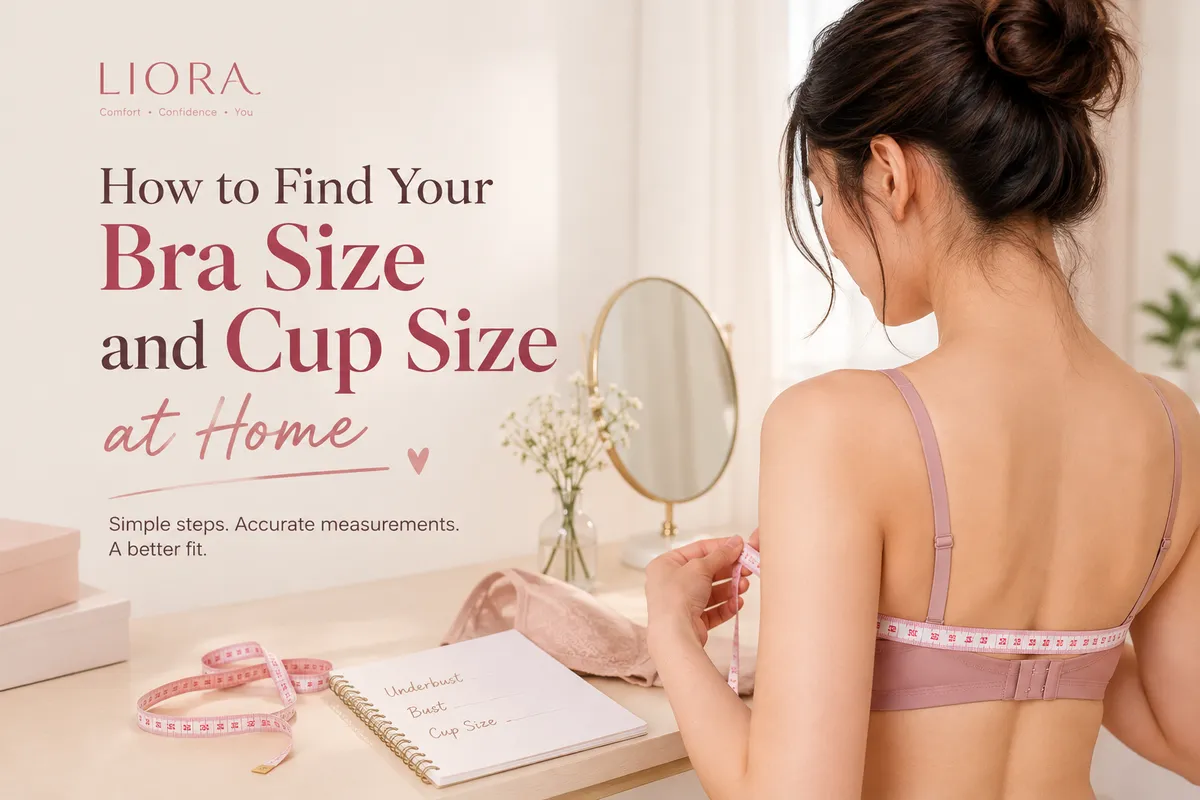
How to Find Your Bra Size and Cup Size at Home
Finding the right bra size can make a big difference in how comfortable, confident, and supported you feel throughout the day. But many women wear the wrong bra size without realizing it.
If your bra straps keep slipping, the band feels too tight, the cups gape, or your breasts spill out from the sides or top, your bra may not be the right size or style for you.
The good news is that you don't need to visit a store or try dozens of bras to find your approximate size. With a soft measuring tape and a few minutes, you can measure yourself comfortably at home.
In this guide, we'll show you how to measure your bra size and cup size at home, with simple steps, examples, a cup size guide, and tips to help you find a more comfortable fit.
Why Is Finding the Right Bra Size Important?
A bra is more than just an item of clothing. The right fit can help you feel comfortable and supported throughout your day.
A well-fitting bra should:
- Feel comfortable without digging painfully into your skin
- Keep your breasts comfortably inside the cups
- Stay in place when you move
- Have a band that feels secure without being uncomfortably tight
- Have straps that sit comfortably on your shoulders
- Provide the support you need without excessive pressure
If your bra constantly feels uncomfortable, needs frequent adjustment, or doesn't sit properly on your body, it may be time to recheck your measurements.
What Do You Need to Measure Your Bra Size?
You only need a few simple things to measure your bra size at home:
- A soft measuring tape: A flexible tailor's measuring tape works best.
- A mirror: This can help you check that the tape is positioned correctly.
- A lightly lined or unpadded bra: Optional, if you prefer to measure while wearing a bra.
- Your phone or a piece of paper: Use it to write down your measurements.
If you don't have a measuring tape, you can use a piece of string or ribbon and measure it afterward with a ruler.
Before You Start Measuring
For a more accurate measurement, keep these simple tips in mind:
- Wear a lightly lined or unpadded bra, or measure without a bra.
- Stand naturally and relax your shoulders.
- Don't hold your breath or push your chest forward.
- Keep the measuring tape level around your body.
- Keep the tape snug, but don't pull it so tightly that it digs into your skin.
Find Your Bra Size at Home
Finding your bra size is simple. You generally need two measurements: your underbust measurement and your bust measurement.
Follow these four easy steps to get your starting size.
① Measure Your Underbust
Your underbust measurement is taken directly underneath your breasts, where the bottom band of your bra normally sits.
Wrap the measuring tape around your ribcage, directly underneath your breasts. Make sure the tape stays level all the way around your body.
Keep the tape snug but comfortable. Stand naturally and breathe normally while measuring.
Write down your measurement in inches or centimeters.
This measurement helps determine your band size.
② Measure Your Bust
Next, measure around the fullest part of your bust.
Wrap the measuring tape around the fullest part of your breasts and keep it level across your back. The tape should rest gently around your bust without squeezing or compressing your breasts.
Stand naturally and avoid pulling the measuring tape too tightly.
Write down your bust measurement.
This measurement is used together with your band measurement to estimate your cup size.
③ Calculate Your Cup Size
Once you have both measurements, compare your bust measurement with your band measurement.
Formula: Bust measurement − Band measurement = Cup difference
For example, if your measurements are:
Underbust: 31 inches
Bust: 35 inches
Then:
35 − 31 = 4 inches
A difference of approximately 4 inches commonly corresponds to a D cup in many standard sizing systems.
Cup sizing can vary between brands and sizing systems, so use this calculation as a starting point rather than an absolute rule.
④ Check the Size Chart
After calculating your approximate size, compare your measurements with the size chart for the specific bra you want to purchase.
This step is important because bra sizing can vary between brands, styles, fabrics, and sizing systems.
Always use the product-specific size chart when one is available.
The goal isn't simply to find a number and letter. The goal is to find a bra that feels comfortable, secure, and supportive.
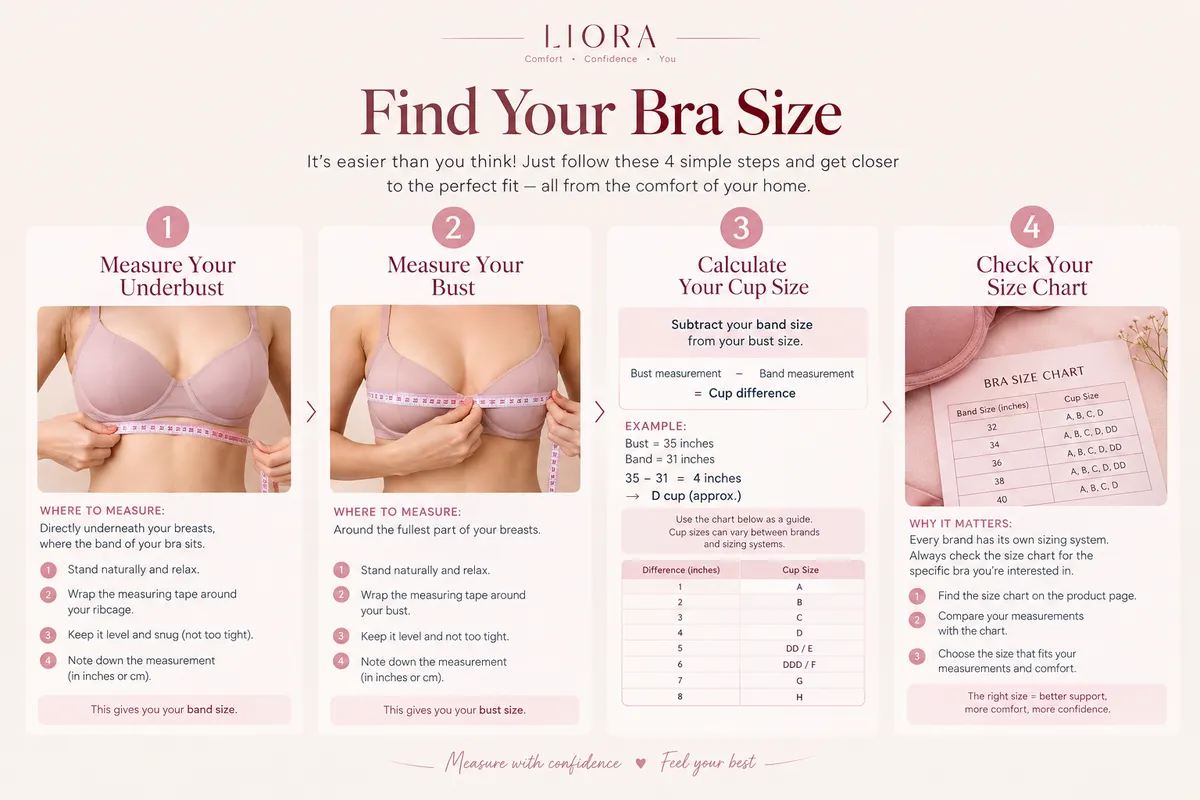
Quick Cup Size Guide
A commonly used starting guide is:
| Difference Between Bust & Band | Approximate Cup Size |
|---|---|
| 1 inch | A |
| 2 inches | B |
| 3 inches | C |
| 4 inches | D |
| 5 inches | DD / E |
| 6 inches | DDD / F |
| 7 inches | G |
| 8 inches | H |
This is a general guide. Cup lettering and sizing conventions can vary between brands and countries, so always check the size chart for the particular bra you are buying.
What Does Your Bra Size Mean?
A bra size usually contains a number and a letter.
For example, in a size such as 34D:
- 34 refers to the band size.
- D refers to the cup size.
The band represents the measurement around your ribcage, while the cup represents the difference between your bust measurement and band measurement.
It's important to remember that cup letters are relative to the band size. A 34C does not have exactly the same cup volume as a 38C.
What Are Sister Sizes?
Sister sizes are bra sizes with related cup volumes but different band measurements.
For example, depending on the sizing system:
34C → 36B → 32D
These sizes have related cup volumes, but their bands fit differently.
If the cup fits well but the band feels too tight, you may need to try a larger band with a smaller cup. If the band feels loose but the cup fits, a smaller band with a larger cup may be worth trying.
Sister sizing is only a general guide. Always consider the actual fit and the individual brand's size chart.
How Should a Properly Fitting Bra Feel?
Your measurements give you a starting point, but the actual fit is the final test.
1. The Band
The band should feel secure without painfully digging into your skin. It should stay relatively level around your body instead of constantly riding up at the back.
The band provides much of the bra's support, so it shouldn't be extremely loose.
2. The Cups
Your breasts should sit comfortably inside the cups.
Look for:
- No significant spilling over the top
- No bulging from the sides
- No large gaps
- No excessive wrinkling
- No uncomfortable squeezing
If your breasts spill out of the cup, you may need a larger cup or a different bra style. If there is significant gaping, you may need a different size or cup shape.
3. The Straps
Your bra straps should stay comfortably on your shoulders without constantly falling down.
However, the straps shouldn't be doing all the work. If you need to tighten them excessively to get enough support, the band or cup may not be fitting correctly.
4. The Center of the Bra
For bras with a center gore, the section between the cups should sit comfortably against your chest when the bra style is designed to do so.
If the cups are cutting into your breasts or the center area doesn't sit as intended, consider trying another size or style.
Common Signs Your Bra May Be the Wrong Size
Not sure whether your current bra fits correctly? Here are some common signs to look for:
Your Band Rides Up
If the back of your bra constantly moves upward, the band may be too loose.
Your Breasts Spill Out
Spillage over the top or sides can indicate that the cup is too small, although the shape of the bra can also affect how it fits.
The Cups Are Gaping
Gaps can mean the cup is too large, but they can also happen because of your breast shape or because the bra style isn't a good match for you.
Your Straps Keep Falling
Loose straps, an incorrect band fit, or the wrong bra style can all contribute to straps slipping from your shoulders.
The Band Feels Painfully Tight
Your band may be too small if it feels uncomfortably tight or digs into your skin.
The Bra Still Feels Uncomfortable
If you've adjusted the straps and band but the bra still doesn't feel right, try another size or a different style.
Why Your Bra Size Can Change
Your bra size isn't necessarily permanent.
Your measurements and breast shape can change over time due to natural changes in your body, weight changes, hormonal changes, pregnancy, breastfeeding, or other life stages.
Even if your measurements remain similar, changes in breast shape can affect which bra styles feel most comfortable.
It's a good idea to recheck your measurements whenever your current bras stop fitting comfortably.
Does Breast Shape Matter?
Yes. Two women can have similar measurements but completely different breast shapes.
Breasts can differ in:
- Fullness at the top
- Fullness at the bottom
- Width
- Projection
- Spacing
- Overall shape
Because of this, two people with the same calculated bra size may prefer completely different bra styles.
Your calculated size is a starting point. The right bra should also suit your shape and provide the comfort and support you need.
How to Measure Your Bra Size in Centimeters
If you prefer centimeters, you can measure both your underbust and bust in centimeters.
For example:
Underbust: 78 cm
Bust: 88 cm
The difference is:
88 − 78 = 10 cm
However, international bra sizing systems do not all convert directly from centimeters in the same way.
European, UK, US, and other sizing systems may use different conventions, so always check the size chart provided by the brand or product.
Can You Find Your Bra Size Without a Measuring Tape?
Yes. If you don't have a measuring tape, you can use a piece of string, ribbon, or non-stretchy cord.
Wrap the string around your underbust and mark where the ends meet. Then lay the string flat and measure it with a ruler.
Repeat the same process around the fullest part of your bust.
Make sure the string isn't stretching while you measure.
Should You Measure Yourself Wearing a Bra?
You can, but choose the right bra for measuring.
A lightly lined or unpadded bra that doesn't significantly change your natural breast shape is generally a better choice.
Avoid heavily padded, push-up, or highly compressive bras because they can change your measurements.
You can also measure without a bra if that is more comfortable for you.
Is Bra Size the Same in Every Brand?
No. This is one of the most important things to remember when shopping for bras online.
A size such as 34C can fit differently between brands, styles, and sizing systems.
Even within the same brand, different bra designs can fit differently because of:
- Cup shape
- Fabric and stretch
- Padding
- Underwire design
- Coverage
- Overall construction
So don't worry if your size changes slightly between different bras.
The goal isn't to fit into a particular number or letter. The goal is to find a comfortable fit.
What If You Are Between Two Sizes?
If your measurements fall between sizes, don't automatically assume that one size is definitely correct.
Consider:
- The bra's specific size chart
- Whether the fabric has stretch
- The style of the bra
- Your breast shape
- How the band feels
- How the cups fit
If possible, comparing the neighboring size can help you find which fit feels more comfortable.
Simple Bra Size Checklist
Before purchasing a bra, remember these five steps:
- Measure your underbust — take the measurement directly underneath your breasts.
- Measure your bust — measure around the fullest part of your breasts.
- Calculate the difference — compare your bust and band measurements.
- Check the brand's size chart — don't rely only on a generic chart.
- Check the fit — the bra should feel comfortable, supportive, and secure.
Frequently Asked Questions About Bra Size
How often should I measure my bra size?
There is no fixed schedule. Consider rechecking your measurements whenever your bras start feeling uncomfortable or your body has changed.
Can I calculate my cup size without knowing my band size?
Not accurately. Cup size is relative to band size, so you need both measurements to estimate your cup size.
Is a bigger cup always a bigger bra?
Not necessarily. Cup letters are relative to the band. A 34D and 36D do not have exactly the same cup volume.
Why does my calculated size not fit?
Your measurements are only a starting point. Brand sizing, breast shape, bra style, fabric, and construction can all affect the final fit.
Why does one bra fit while another in the same size doesn't?
Different bra designs have different cup shapes, coverage, fabrics, and construction. The same labeled size can therefore feel different between styles.
Should my bra feel tight?
A bra should feel secure, but it shouldn't be painfully tight or cause significant discomfort. The band should stay in place without squeezing you excessively.
Can my bra size change over time?
Yes. Your body measurements and breast shape can change over time, so it is completely normal for your bra size to change.
The Bottom Line
Finding your bra size at home doesn't have to be complicated.
All you need is a soft measuring tape and a few minutes.
Measure your underbust → Measure your bust → Calculate your cup size → Check the size chart → Check the fit.
And remember: your bra size is a guide, not a permanent label.
Comfort, support, and the way the bra fits your unique shape are what matter most.
At Liora, we believe lingerie should make you feel comfortable, confident, and beautiful. Whether you're looking for everyday support, something delicate and feminine, or a style that complements your outfit, choosing the right size is the first step toward finding a bra that truly feels right for you.
Measure with confidence. Choose your fit. Feel comfortable in your own skin.
Keep reading
Fit & Care8 min read
Different Types of Bras and When to Wear Them
Explore the different types of bras and learn when to wear each bra style. From T-shirt, push-up, plunge, and strapless bras to sports, lace, wireless, and nursing bras, find the right bra for comfort, support, and every outfit.